When considering the debate of curved treadmill vs flat, many fitness enthusiasts wonder, "What are the benefits of using a curved treadmill vs a flat one?" According to Dr. Michael Jones, a renowned fitness expert, “Curved treadmills engage more muscle groups, bringing a whole new level to workout efficiency.”
Curved treadmills mimic natural running motions. The design allows for an self-propelling experience that can lead to a more effective workout. Users often report improved endurance and better overall performance. The curvature of the treadmill encourages a forward lean, which can foster better form and reduce impact.
Conversely, flat treadmills remain popular for their simplicity and ease of use. This traditional style still has its merits, such as accommodating various fitness levels. However, some might find flat treadmills less challenging over time. As you weigh the options, reflect on your fitness goals and preferences. Each type offers unique benefits that can dramatically influence your training outcomes.
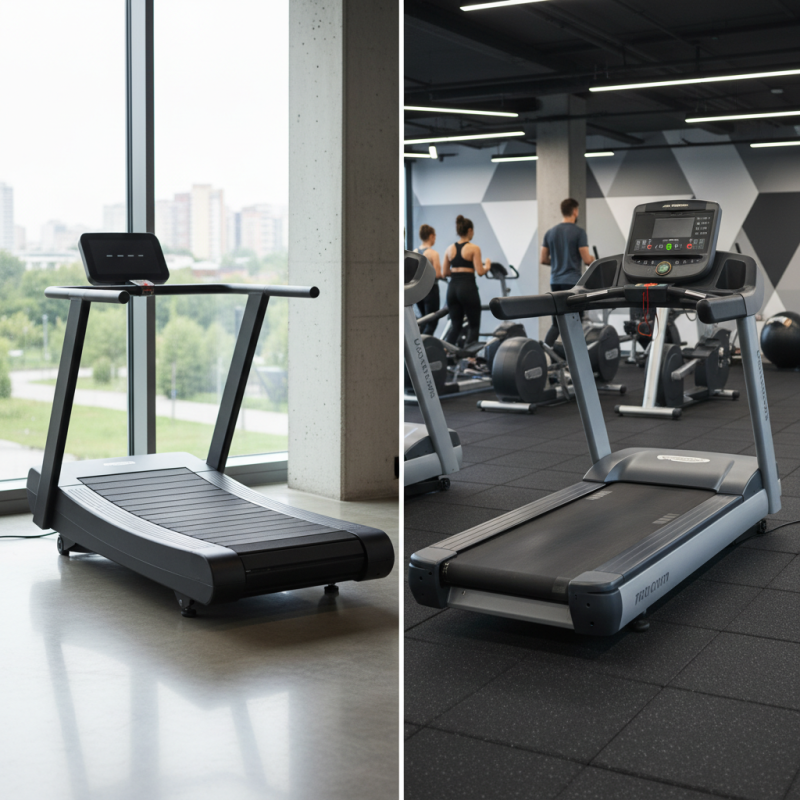
Curved treadmills present a unique design and functionality that stand out in the fitness landscape. Unlike traditional flat treadmills, they feature a curved running surface. This design promotes a more natural stride, which can reduce the risk of injury. A report from the American Council on Exercise notes that using a curved treadmill can enhance cardio engagement by up to 30% compared to flat models.
The mechanics of a curved treadmill encourage users to push against the surface, which activates different muscle groups. This results in a more intense workout in a shorter duration. Data from various fitness studies indicate that users can burn up to 40% more calories in the same time frame than on conventional treadmills. However, the lack of a motor may require an adjustment period for new users. It can be challenging to find the right pace, leading to frustrations initially.
Functionality extends beyond calories burned. Curved treadmills often have a lower environmental impact since they require no electricity. Maintenance can also be easier as there are fewer mechanical components. Yet, the price point may deter some users. Reflecting on these aspects can help individuals make informed decisions about incorporating curved treadmills into their fitness routines.
The chart above illustrates the comparative key benefits of curved treadmills versus flat treadmills. Curved treadmills score higher due to their natural running motion and increased engagement of muscle groups, while flat treadmills are simpler and more accessible but provide fewer functional advantages.
Flat treadmills are widely utilized for their straightforward design and functionality. These machines feature a flat running surface that can easily accommodate various workout routines. They typically come with a motorized system, allowing users to adjust speed and incline settings. This adaptability makes them suitable for users of all fitness levels. According to a report by the American Council on Exercise, around 60% of gym-goers prefer flat treadmills for their ease of use.
The mechanism behind flat treadmills focuses on efficiency and user control. Users can seamlessly switch speeds, creating interval training sessions that enhance cardiovascular health. Research indicates that running on a flat treadmill can burn approximately 30% more calories than walking. However, some users may find them monotonous after a while. Without variation, workouts may become stale, potentially leading to decreased motivation. The challenge lies in maintaining engagement while maximizing efficiency.
Despite the advantages, flat treadmills have limitations. They often lack the dynamic feature of curved treadmills, which require users to generate their own momentum. While flat treadmills offer greater control, the passive mechanism can sometimes hinder muscle engagement. Participants looking to optimize their workouts should consider their fitness goals carefully. Balancing consistency with variety can lead to more sustainable training patterns.
Curved treadmills have gained attention for their unique design and benefits. Unlike flat treadmills, they feature a concave surface that aligns with the natural biomechanics of the human body. This design promotes a more ergonomic way to run or walk. Users often report less strain on their joints because of this alignment.
One significant health benefit is the increased calorie burn. Research indicates that running on a curved treadmill can lead to a 30% increase in calorie expenditure compared to traditional flat treadmills. This is due to the self-propelling nature of the curved surface. Users must engage their muscles more actively, leading to a more efficient workout.
Many find that using a curved treadmill helps improve their running form. The natural curve encourages proper posture and stride length. However, it can be challenging for beginners to adjust to the mechanics. Some users might feel fatigued faster, requiring a gradual adaptation period. Overall, incorporating a curved treadmill can enhance fitness routines, but it's essential to listen to your body during training.
Flat treadmills offer numerous advantages for home workouts. They provide a stable surface that is ideal for various exercises. Research indicates that a flat treadmill can reduce the risk of injury, as it promotes a natural running gait. According to a study by the American Council on Exercise, 60% of runners prefer flat surfaces for safety.
Many health enthusiasts appreciate the versatility of flat treadmills. They allow users to control speed and incline settings easily. This flexibility caters to varying fitness levels and goals. A flat treadmill can support interval training, which has shown to boost cardiovascular fitness. A report from the Journal of Sports Medicine notes that just 20 minutes of interval training can significantly improve heart health.
**Tip:** Start with a moderate pace to understand your comfort level. Gradually increase intensity as your fitness improves.
While flat treadmills are beneficial, they may lack the engaging challenge of curved models. Some users find themselves bored after a while. To combat this, consider incorporating interval workouts or listening to upbeat music. Keeping your sessions interesting will enhance motivation and persistency.
| Feature | Curved Treadmill | Flat Treadmill |
|---|---|---|
| Natural Running Experience | Yes, mimics outdoor running | Limited, requires manual adjustment for incline |
| Muscle Engagement | Higher engagement of glutes and hamstrings | Lower muscle engagement, primarily legs |
| Space Requirement | Typically more compact | Larger footprint required |
| User Experience | More engaging and interactive | Basic functionality, less engaging |
| Calibration and Maintenance | Minimal maintenance required | May require regular maintenance and calibration |
| Cost | Higher initial investment | Generally more affordable |
When comparing curved treadmills and flat treadmills, several factors stand out. Curved treadmills require users to utilize their own power to move the belt. This means that the machine doesn't have a motor. This design encourages natural running mechanics. It can lead to a more intense workout. Users often report higher calorie burns in a shorter time on curved models.
Flat treadmills, on the other hand, feature a motorized belt. They provide a consistent pace and can be easier for beginners. However, users may lack engagement compared to curved options. With flat treadmills, the workout can become monotonous. The flat design allows for steady pacing, which is beneficial for endurance training but may not fully test one's limits.
It's essential to consider individual goals. If you're seeking intensity, a curved treadmill might be more beneficial. If recovery or gentle workouts are the aim, a flat treadmill could suffice. Each has its merits and drawbacks, making personal preference crucial in choosing the right equipment. The efficiency of each type ultimately depends on the user's fitness journey and personal motivation.
: A curved treadmill features a curved running surface, promoting a natural stride and reducing injury risk.
It can enhance cardio engagement by up to 30% compared to flat treadmills, according to fitness reports.
Yes, users may burn up to 40% more calories in the same time frame compared to conventional models.
It may take time to adjust since there's no motor, making it challenging to find the right pace initially.
Curved treadmills require no electricity, making them more environmentally friendly than traditional models.
Yes, they offer a stable surface, reduce injury risk, and allow users to control speed and incline easily.
Incorporate interval training or listen to music to enhance motivation during workouts.
Yes, they support various exercises and interval training, beneficial for improving cardiovascular fitness.
Begin with a moderate pace to gauge comfort, then gradually increase intensity as your fitness level improves.
Some users may find flat treadmills less engaging than curved models, leading to boredom over time.
The article "Curved Treadmill vs Flat: What Are the Key Benefits?" explores the distinct advantages and functionalities of curved and flat treadmills. Curved treadmills are designed to enhance running efficiency by engaging more muscle groups and promoting a natural running motion, leading to improved cardiovascular health and calorie burn. In contrast, flat treadmills offer practical features such as adjustable incline and speed settings, making them suitable for home workouts and diverse training programs.
When considering "What are the benefits of using a curved treadmill vs a flat one?", it's essential to recognize that curved treadmills may provide a more intense workout experience, fostering greater engagement and effort. Meanwhile, flat treadmills remain a versatile option for varied fitness routines, catering to different user preferences. Ultimately, the choice between the two depends on individual fitness goals and workout styles, as each type of treadmill offers unique benefits tailored to different needs.

Naturist Fitness